FutureBrand—Architecture—Logo
c

The future of brand is not image, but a growth decision system.

Future Brand System elevates the brand from a mere communication asset to a foundational decision logic and strategic response architecture. This transformation enhances the organization's capability to interpret market signals, precisely identify winnable arenas, and drive growth with strategic direction and systematic discipline.
Where is your growth leaking?
Complete this 5-min assessment to identify the strategic vulnerabilities currently hindering your business growth.
For executive readers
Download the Future Brand System Executive Summary to understand how brand becomes a decision architecture for growth, alignment, and AI-era scalability.

The Root of Business Growth Stagnation : Leaks in the Growth Ecosystem

Many organizations do not slow down due to a lack of operational efficiency, but rather lose strategic momentum because of 6 Growth Leaks. These leaks prevent high-volume business activities from effectively converting into sustainable profit and full-potential growth.
1. Scalability Leak
Founder Dependency; when core logic is not converted into an operating system, the organization lacks the ability to achieve Scalability.
2. Direction Leak
Strategic ambiguity leading to misaligned interpretations between leadership and the team, causing misallocated resources, wasted investments, and lost growth opportunities.
3. Worth Leak
The disparity between true potential and actual value structuring, making it impossible to communicate value that justifies a customer's Willingness To Pay.
4. Differentiation Leak
Unclear differentiation and a lack of justified advantage force customers to decide primarily on price, losing the capability to command a winning market position.
5. Trust Leak
A lack of unity between brand identity, commercial offerings, communications, and employee behavior creates a value perception gap for customers.
6. Adaptability Leak
Delayed response to market dynamics due to decisions rooted in outdated assumptions and historical data, lagging behind emerging demands.
The Invisible Costs
These leaks represent "Invisible Costs" that erode organizational efficiency. They manifest as compressed profit margins, declining conversion rates, and the misapplication of AI which may inadvertently amplify systemic misalignments and accelerate inefficiency if not governed by a robust Brand Logic.
FutureBrandSystem-Logo-Text

Strategic Architecture for the Modern Growth Context

Future Brand System is a strategic decision-making architecture designed for businesses that can no longer afford fragmented growth. This system redefines the brand as the core Business Logic, governing organizational direction by clarifying what to pursue and what to reject. It systematically establishes brand promises, value verification, delivery, measurement, and continuous improvement protocols.

The primary objective extends beyond mere aesthetic enhancement; it is to build an organizational capability for decisive and high-precision decision-making. By fostering operational alignment across the entire enterprise, the system enhances adaptability to change and enables efficient, systematic scaling of the growth foundation.
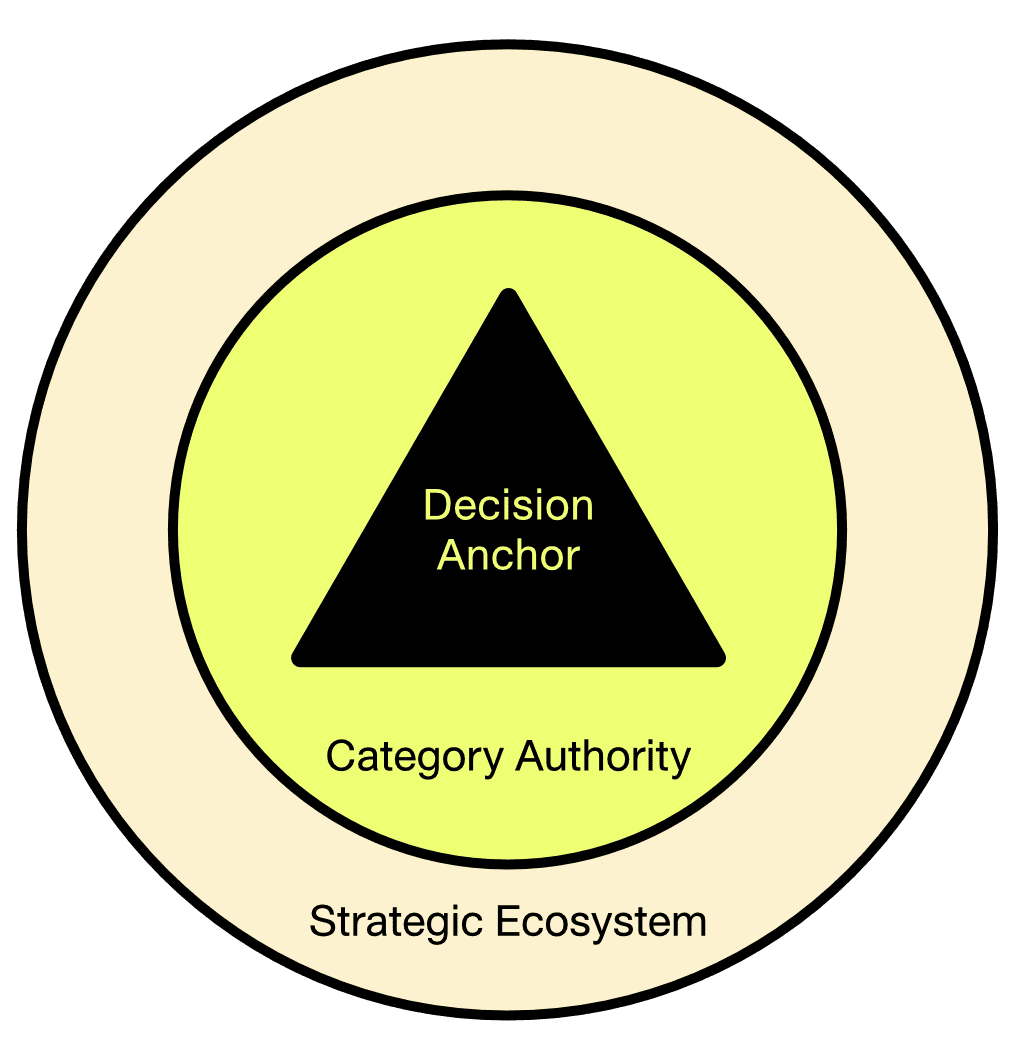
FutureBrandSystem 3 Strategic Moves: Decision Anchor, Category Authority, Strategic Ecosystem

Move 1
Decision Anchor

Establish a Definite Decision Anchor
This phase involves building a stable conceptual foundation by clarifying the core principles upon which the business stands. This process enables the organization to precisely identify primary priorities and establish decisive benchmarks for rejecting any initiatives that do not align with the core business direction.

Move 2
Category Authority

Connect the business to market shifts, customer tensions, and competitive white space.
This move connects business potential with significant market dynamics and shifts. By focusing on analyzing customer friction points or unmet needs, the business identifies opportunities to present new alternatives. The ultimate goal is to pinpoint and dominate competitive gaps where no other rival has established a clear ownership position.

Move 3
Strategic Ecosystem

Turn strategy into value, alignment, execution, measurement, and repeatable growth behavior.
This stage translates high-level strategy into tangible value through rigorous execution. The system creates alignment between operations and performance measurement across the entire organization. By developing systematic and repeatable growth behaviors, the business ensures scalable expansion that is sustainable over the long term.

A brand story and Image are no longer enough, today's business environment demands a decision logic.

Over the next five years, businesses will no longer be able to rely solely on brand storytelling or visual consistency to secure a sustainable competitive advantage. As the proliferation of AI makes the creation of identities, logos, content, and communication campaigns increasingly effortless, brands face a heightened risk of imitation, leading to a marketplace saturated with indistinguishable offerings.

While these communication tools remain essential, as standalone assets they are insufficient to bridge the "Strategic Leaks" that obstruct growth. A business may achieve an improved aesthetic image, yet still lack the critical capabilities required for high-precision decision-making, accurate market signal interpretation, or the systematic unification of team performance.

The true competitive advantage has shifted toward achieving Strategic Coherence, a state of total systemic alignment. By repositioning the brand as a Decision Logic, it serves to elevate the quality of business judgment. This transformation provides the capability to identify the most high-impact opportunities, rapidly align team behaviors, and integrate operational structures across the entire organization with the precision required to be future-ready.
Old Brand Model
  • Brand as Visual Identity (Awareness)
    Focuses on building brand recognition and creating a memorable image.
  • Differentiation
    Concentrates on establishing unique selling points to stand out and remain top-of-mind.
  • Storytelling
    Emphasizes value creation through narratives and capturing market attention.
  • Historical Market Data (Insight)
    Driven by legacy customer data, competitive analysis, and market behaviors that proved effective in the past.
  • Campaign-Led Communication
    Driven by periodic marketing stimuli and cyclical budget allocations.
  • Consistency for Memorability
    Builds credibility through the stability of brand identity and visual expression.
  • Marketing Department Function
    Responsibility is limited strictly to the dimension of brand communications.
  • AI for Content Production
    Utilizes AI tools for aesthetic enhancement, increasing content volume, and expanding reach.
Future Brand System
  • Brand as Decision Infrastructure (Growth)
    Focuses on systematically driving business growth through strategic logic.
  • Market Dominance
    Prioritizes occupying uncontested market spaces to establish category leadership.
  • Decision Logic
    Ensures high precision in every strategic investment to maximize returns.
  • Adaptive Future Sensing (Insight & Foresight)
    Integrating market signals and emerging behaviors to enable rapid awareness and high-precision decision-making.
  • Growth Behaviors
    Connects strategy to an operating system capable of producing consistent and sustainable results.
  • Consistency for Desirability
    Build confidence through rigorous decision-making standards and consistent business outcomes.
  • Total Business Alignment
    Synchronizes all teams across the organization toward a singular strategic objective.
  • AI Co-Logic for strategic decision
    Integrates AI as a strategic partner to enhance precision, navigate volatile markets, and scale competitive advantage.

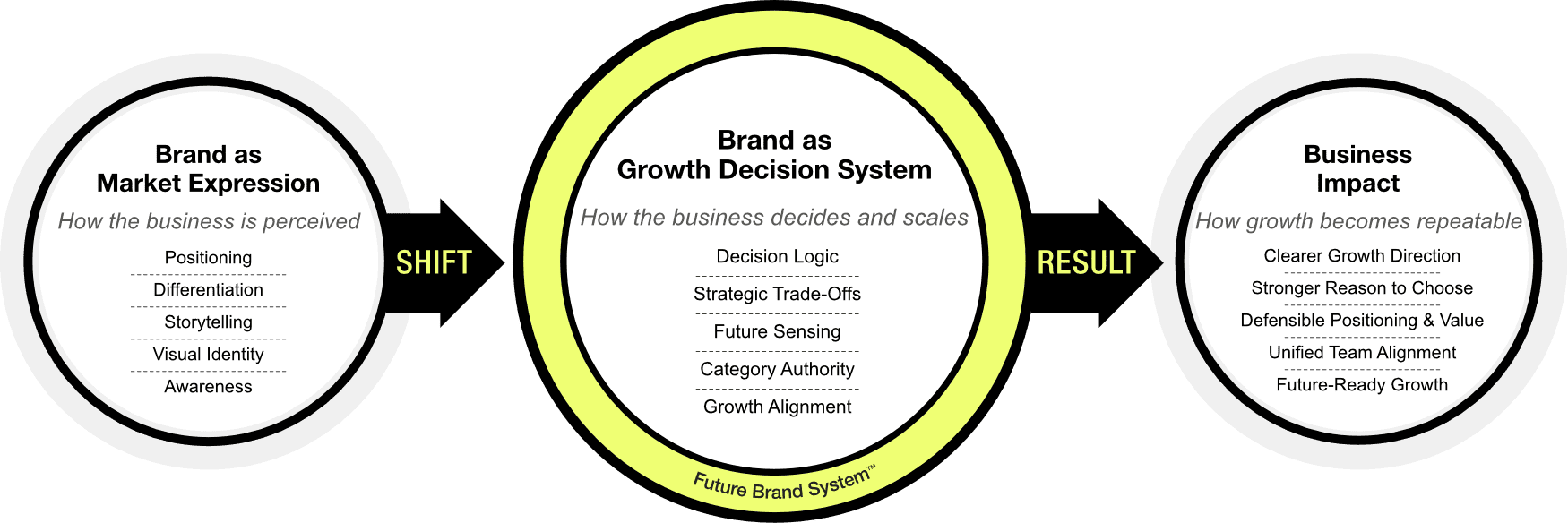
From Branding For Market Perception
To Branding As Business Operating Logic For Growth.

Shift Diagram: from Market Expression to Growth Decision System

Why future brand system is essential in an era of rapid AI-driven lmitation.

In an era where AI-driven production allows competitors to mirror brand aesthetics instantaneously, customers are faced with overwhelming choices, leading to diminished brand loyalty. Simultaneously, teams face intensified pressure to manage multi-channel communications within a rapidly shrinking margin for ambiguity.

AI does not inherently dictate strategic direction; rather, it serves as an amplifier of existing intent. If positioning lacks clarity, AI merely accelerates the production of directionless communication. If a value proposition remains generic, AI will only scale that mediocrity across a broader reach. Furthermore, without a robust market sensing system, AI becomes a tool that hastens legacy operations without providing the capability to prepare for structural shifts in the future.

Conversely, when a business is anchored by a clear Brand Logic, Market Logic, and Future Signals, AI transitions into a Strategic Co-Logic. In this capacity, it enhances the analysis of market signals, consumer behaviors, and emerging demands, while providing deep insights into market feedback. This intelligence is then funneled back to refine decision-making accuracy, optimize value propositions, tailor communications, and realign operational systems to meet real-world dynamics with maximum efficiency.
Business Impact & Risks
  • Resource Depletion:
    Operating without clear priorities results in wasted marketing budgets and exhausted team energy.
  • Growth Resistance:
    Weakening conversion rates and intensifying price pressure force businesses to exert greater effort to maintain baseline revenue, steadily eroding profit margins.
  • Strategic Misalignment in a Shifting Market:
    Anchoring to legacy assumptions leads to market invisibility. Failing to adapt to evolving demands erodes competitive advantage, ultimately resulting in organizational obsolescence.
  • Scalability Barriers:
    Delayed decision-making and an over-reliance on the Founder prevent the organization from establishing the standards necessary for sustainable growth.
  • Amplification of Errors via AI:
    Without a clear strategic direction, AI technology will only accelerate and intensify internal organizational misalignment.
Future Brand System Facilitates

Protect Profit Margins

Establishing sharp positioning and a clear value logic, businesses mitigate the risk of being judged solely on price, thereby securing a sustainable competitive advantage.

Accelerate Decision-Making

Utilizing a Decision Anchor as a shared standard enables leaders and teams to act with greater agility and precision, reducing the organizational dependency on the Founder for every stage of decision-making.

Aligning Business with Real Market Demand

Integrating Brand Logic, Market Signals, Customer Behavior, and Emerging Demand accelerates market sensing. By identifying current value drivers, businesses can align offerings and growth trajectories with the unfolding future.

Eliminate Operational Waste

This system integrates strategy, offerings, communications, and organizational behavior under a unified logic. This alignment ensures a consistent customer experience while eliminating redundant resource consumption.

Govern AI with Strategy

AI delivers its highest value when governed by clear decision criteria. Without a foundational Strategic Logic, technology only serves to accelerate and intensify structural misalignment within the business.
At BrandMadeFuture, we view branding not as a visual identity detached from financial performance, but as a Strategic Operating Logic that elevates decision quality. This framework sharpens strategic trade-offs, aligns the business with real market demands, and establishes a Sense & Respond system that ensures the organization is future-ready.


The 3 Strategic Moves Behind Future-Ready Growth

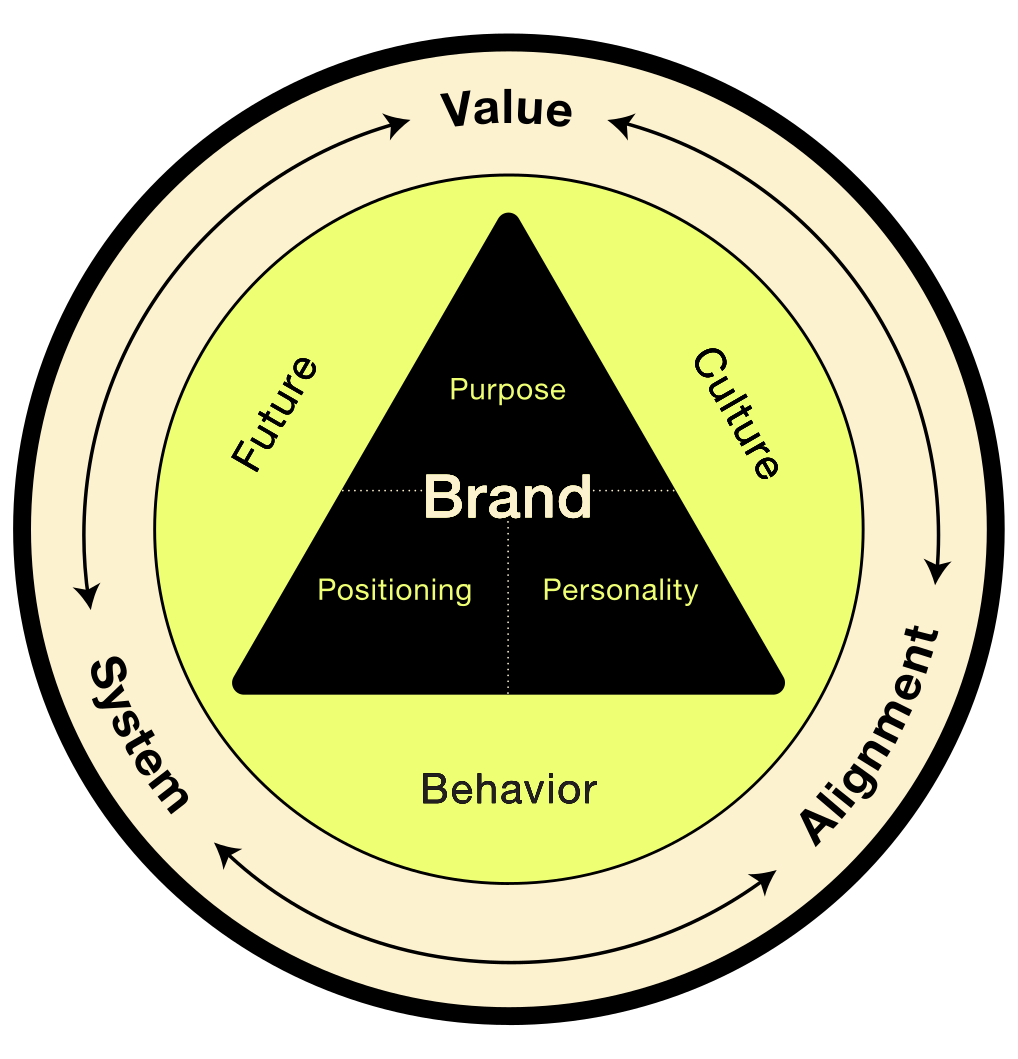
The Future Brand System transforms branding from a visual identity into a Growth Decision System. This process begins by establishing a Decision Anchor to set a clear strategic direction. It identifies the Right to Win by analyzing the intersection of business capabilities, emerging demands, and market signals. Finally, strategy is converted into a Strategic Operating System, integrating personnel, value propositions, and AI Workflows to drive tangible, sustainable results.
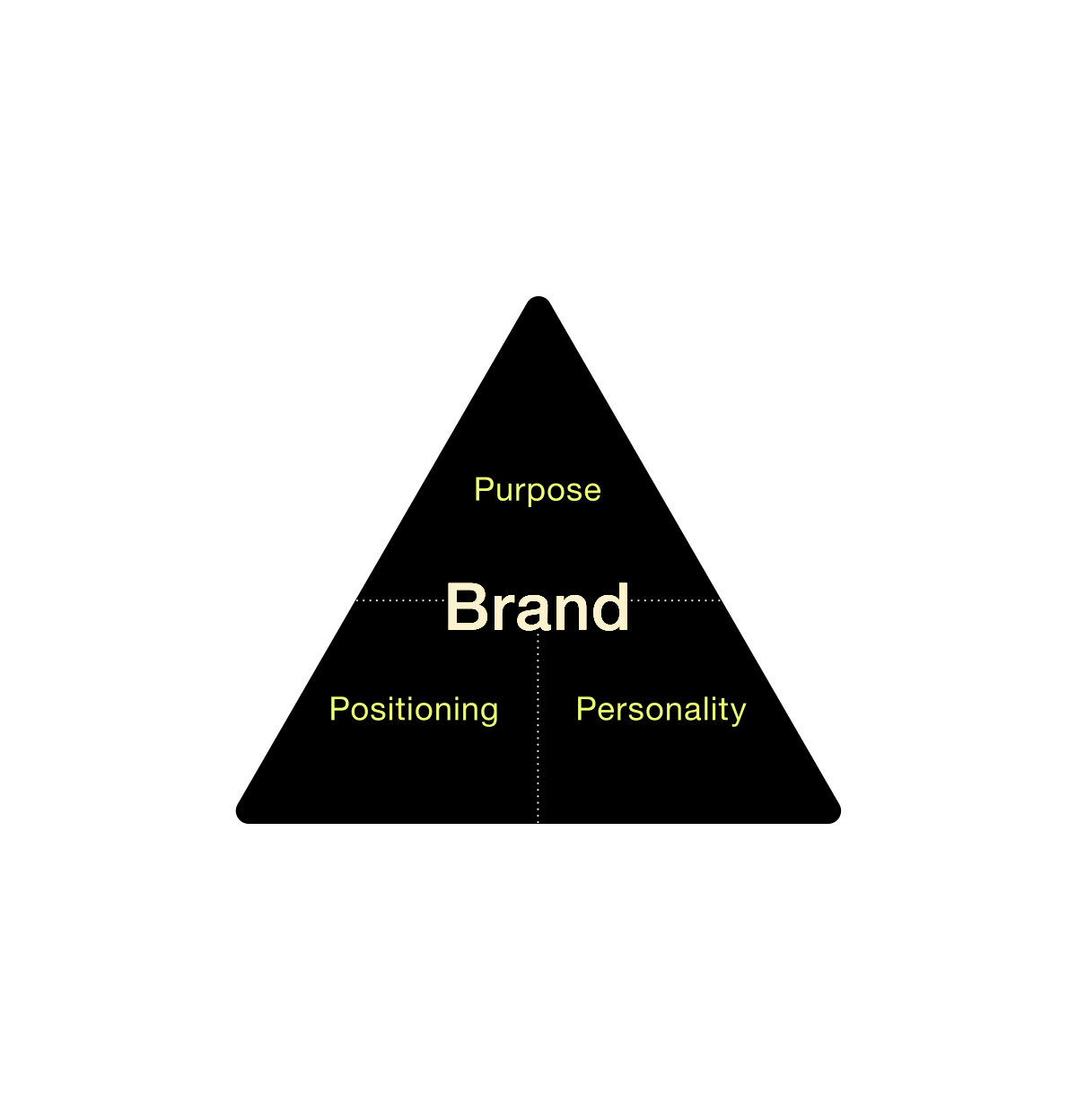
Simple red triangle with the word “BRAND” in the center, symbolizing the foundational core of the Future Brand System methodology

Move 1 :
Decision Anchor

Create decision control before growth expands

Establishing a standard for directional control prior to expansion ensures that every growth strategy is built upon a rock-solid foundation.

A Decision Anchor serves as the strategic core that defines what the business stands for, which objectives to prioritize, what initiatives to reject, and the specific principles to apply when faced with critical trade-offs.

Purpose

Belief → Boundary → Bet
Strategic Conviction • Resource Prioritization • Long-Term Direction
Defines the strategic reason for the business's existence, a value that transcends short-term sales, acting as a filter for selecting opportunities, investments, partnerships, and organizational priorities.

Positioning

Competitive Logic → White Space → Ownership Claim
Reason-to-Choose • Market Distinction • Competitive Advantage
Provides the logic for selecting competitive arenas where the business has the highest potential to win, clarifying the strategic space the brand occupies and reinforcing the definitive reason why customers should choose you over competitors.

Personality

Standard → Signal → Structure
Behavioral Consistency • Trust Signals • Cultural Reinforcement
Sets the behavioral standards that align communication, sales, and service in a single direction; this is not merely a brand persona, but a set of operational principles that ensure the entire team executes and expresses the brand consistently across the organization.
Move2-Category-Authority

Move 2 :
Category Authority 

Build market relevance before the market moves past you

A business must not only define a clear identity but also identify the specific market space where it can truly achieve victory. This requires the seamless integration of business strengths, market demands, and emerging signals into a unified front.

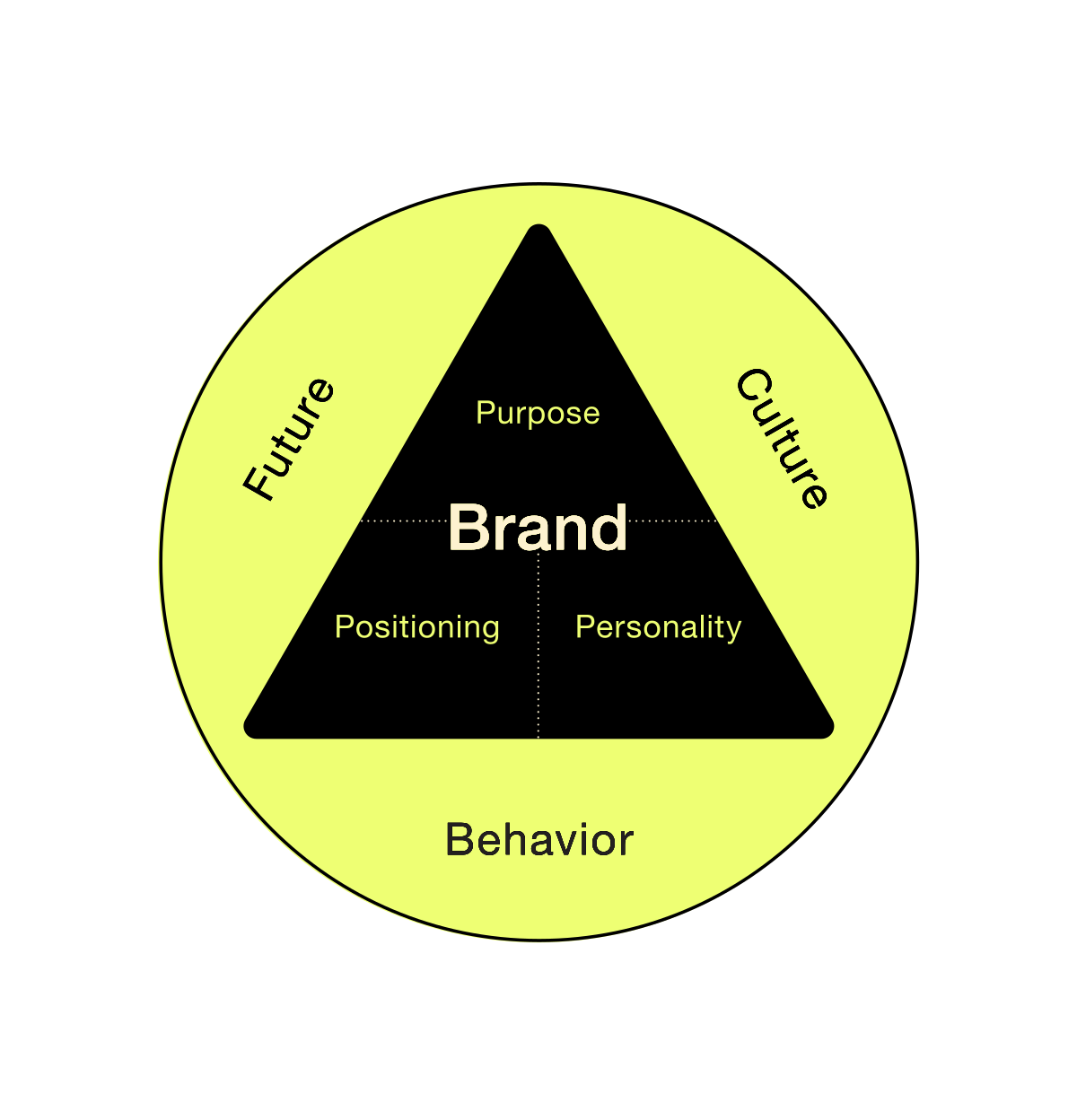
Establishing Category Authority elevates the brand into a Strategic Antenna that analyzes future trends, culture, and behavioral shifts. This shifts the organization’s role from a market follower to a proactive leader capable of precisely sensing and shaping demand.

future

Sensing → Shift → Timing
Market Foresight • Opportunity Timing • Strategic Adaptation
Monitor and identify "Signals of Change" that influence customer priorities, category expectations, and future brand relevance.

culture

Tension → Meaning → Movement
Demand Relevance • Cultural Resonance • Meaning Creation
Analyze the beliefs, tensions, and social contexts that define what customers value or fundamentally oppose.

behavior

Friction → Motivation → Adoption
Customer Motivation • Adoption Drivers • Behavioral Shift
Translate insights into customer behavior into actionable alternatives to design offerings, communications, sales processes, and experiences that address real-world utility.
FUTURE-BRAND-SYSTEM Growth Decision System

Move 3 :
Strategic Ecosystem 

Turn strategy into repeatable growth behavior

Even with a sharp strategy, failure can occur if a business lacks a robust execution system. Many organizations struggle with misaligned priorities, off-target offerings, fragmented communication, and the use of AI without strategic oversight.

Building a Strategic Ecosystem is the key to bridging the gap between vision and operation. Designed as a Living System with continuous Feedback Loops, it harmonizes communications, sales, customer experience, team behavior, performance metrics, and AI Workflows to remain seamlessly aligned with market dynamics.

value

Promise → Proof → Premium
Value Perception • Willingness-to-Pay • Margin Strength
Design and reinforce a clear delivery of value to build trust and provide the definitive reason why customers choose you, directly impacting the preservation of business margins.

alignment

Architecture → Action → Experience
Organizational Consistency • Execution Alignment • Experience Integrity
Integrate leadership, teams, communications, sales, and customer experience to operate under a unified logic and shared priorities across the entire organization.

system

Strategy → Sync → Scale
Operational Scalability • Strategic Synchronization • AI-Assisted Execution
Establish the infrastructure that facilitates consistent performance, supports rigorous decision reviews, ensures precise measurement, and enables sustainable business scaling.

Read the
Future Brand System
 Full White Paper

A strategic paper for founders, CEOs, and executive teams who want to turn brand from communication into a decision system for growth. The White Paper explains how Decision Anchor, Category Authority, and Strategic Ecosystem work together to reduce scattered strategy, weak differentiation, team misalignment, and tactical AI overuse.

Why Businesses Should Start Building Decision Infrastructure Now

In an era of high market volatility, where information is easily compared and AI allows for the rapid imitation of brand image and communication strategies, competitive advantage no longer stems from production volume or speed alone. Instead, it lies in decision-making precision, rapid response to market dynamics, and maintaining a unified strategic direction amidst constant change.

If an organization continues to operate on legacy assumptions and relies on the decisions of a small group of individuals, strategic ambiguity becomes a cost that intensifies every quarter. This leads to wasted budgets, misaligned teams, offerings that fail to meet real demand, and growth that is stifled by price wars.

The Contrast of Crisis vs. Systematic Support

Current Business Challenges

  • Fragmented Strategy:
    A fundamental lack of a strategic core required for high-precision decision-making.
  • Diluted Positioning:
    Market positioning is insufficiently sharp to create lasting customer recall.
  • Market Lag:
    Failing to align with evolving market demands.
  • Lack of Team Unity:
    Internal teams are misaligned, with various departments pulling organizational energy in conflicting directions.
  • Pricing Pressure:
    An escalating loss of the ability to protect and maintain healthy profit margins.
  • Stagnant Growth Momentum:
    Execution is delayed and suffers from a lack of operational efficiency.
  • Over-reliance on Individuals:
    Organizational growth is bottlenecked by the personal discretion and limited capacity of the Founder.

The FBS* Outcomes

  • Clear Decision Logic:
    Establishes a shared, universal standard for decision-making across the entire organization.
  • Defendable Positioning:
    Safeguards the brand against imitation and simplifies the communication of a clear market stance.
  • Future-Ready Sense & Respond:
    Detecting market signals and adapting instantaneously.
  • Unified Organizational Alignment:
    Every team recognizes clear priorities and operates under a singular, cohesive purpose.
  • Verifiable Value:
    Provides a clear framework to explain and prove the brand's value proposition to the market.
  • Synchronized Operations:
    Enables consistent execution with a clear, predefined strategic direction.
  • AI-Enhanced Judgment:
    Leverages technology to scale and amplify accurate strategic decisions.
FutureBrand—Score—Logo-Text-BK

Identify the critical factors holding back your growth both today and in the future.

For partners and institutions
Bring Growth Decision System thinking to your SME community, executive audience, HR/L&D network, or leadership program.
web-Growth-Decision-Framework

Access the
Partnership Brief

กรุณากรอกข้อมูลของคุณเพื่อดาวน์โหลดชุดข้อมูลฉบับเต็ม รวมถึงเกณฑ์การวินิจฉัยจุดรั่วไหลทางการเติบโต และรูปแบบโปรแกรมร่วมมือสำหรับพันธมิตร

Access the
Partnership Brief

Enter your business details below to instantly download the complete overview, including the Partnership Brief, Growth Leaks Proof Pack, and pilot collaboration formats.
92% of consumers say a positive experience makes them more likely to buy again.
(Salesforce, 2023)
91% of consumers would buy from an authentic brand.
(Adweek, 2015)
86% of consumers are willing to pay more for a great customer experience.
(PwC, 2024)
77% of consumers buy from brands that share their values. 
(Havas Group, 2023)
77% of consumers buy from brands that share their values. 
(Fox+Hare, 2024)
23% average revenues increase through consistent brand presentation across all platforms.
(Forbes, 2021)
BrandMadeFuture
This website uses cookies.
We use cookies to enhance your browsing experience, analyze site traffic, and understand visitor behavior.